Search This Blog

Friday, July 31, 2020

The Mallard Duck

    The Mallard Duck (Latin name: Anas Platyrhynchos) is a slightly large waterfowl. It is very clearly sexually dimorphic. Males have pronounced green head and bright yellow bills. Females are drab with orange-yellow bills. They live in almost any wetland environment (Ex. marshes, ponds, lakes, city parks). The Mallard is on low conservation status, in 2014 their population was about 11.6 million. 
    Mallards form pairs in the fall and winter and they migrate in early spring. The males follow the females to the breeding area. The breeding area is usually on the ground and no more than 1 mile from water. 
    The female Mallard builds the nest in a shallow depression in the ground near water. The nest is built close to the water and is usually concealed with vegetation or an overhang. During Egg-laying the female lines the nest with grasses, twigs, and leaves; and pulls vegetation over themselves and the nest. Typically a female Mallard lays between 1-13 eggs per clutch. After incubation, the Mallard plucks her own down feathers from her breast and lines the nest and covers the eggs with them.
    The Mallard is omnivorous, but primarily eats seeds, grass, and other vegetation. Their diet shifts during different parts of the year. During the breeding season, they primarily eat aquatic insect larvae, earthworms, snails, and freshwater shrimp. During Migration, they mainly eat seeds and grains.
Mallards

Thursday, July 30, 2020

The Wild Turkey


Fernando Recalde 


           Wild Turkey, Meleagris gallopavo, or "large gallinaceous bird with fan-shaped tail," can weigh anywhere from 5.5 to 24 pounds. It has a length of 2.5 to 4.1 feet with a lifespan of 3 to 5 years in the wild. Wild Turkey is sexually dimorphic, with males being more colorful, and females being more camouflaged better with dull colors. They're located in a total of 49 states across the United States and Hawaii, this number including the other 6 subspecies of Wild Turkey. The Eastern, Merriam, Rio Grande, Florida, Gloud, and Ocellated are all counted as Wild Turkey. They all have different plumage and unique habitats but are part of the same species. Wild Turkey chooses to live a nomadic life, they wander around and don't migrate. Wild Turkey is opportunistic, they usually get around by walking and not by flying or running. Male Wild Turkey, Gobblers, attract female Wild Turkey, Hens, by displaying their tail and humming at females. The Diet of a Wild Turkey includes Nuts, Snails, acorns, fruit, berries, grain, plant parts, insects, and more. Wild Turkey chooses to nest at the ground in dead leaves near trees but may choose to nest in open hay fields. Wild Turkey has a population of around 6 million, with a 7 out of 20 on the concern scale and are not on a bird watch list. 
 

Wild Turkey - eBird | Aves


Tuesday, July 28, 2020

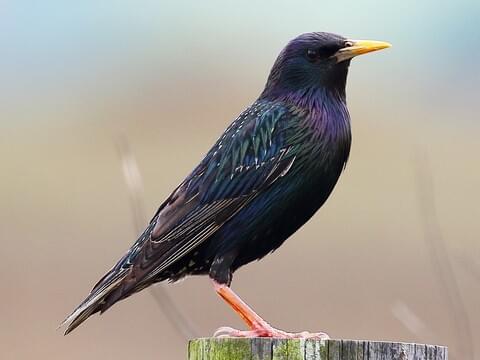
European Starling


      Harrison Holloway


                The European Starling or Sturnus Vulgaris is a medium sized passerine bird. These birds are 8.6 inches in height and can they weight about 2- 3.6 oz. They belong to the sturnidae bird family, and they can live to be fifteen years old. These birds can be found in North America, Northern Africa, Europe, and Southern Australia. European Starlings are not native to the Untied States, they were brought by a man named Eugene Schieffelin in the 1890s.  European starlings are tenacious, energetic and can be aggressive during mating season. In the fall and winter months they would form large roosting flocks that can number up to one million birds. Their diet consists of millipedes, spiders, mollusks, and a few crustaceans. Male starlings build nest to attract the females. They build their nests out of grass, pine needles, feathers, trash, and clothing. Females can lay between three or six eggs, and the incubation period can last from twenty-one to twenty- three days. European Starlings live in man-made areas like cities or towns. These birds can also live in coastal areas, open forests, and mountain ranges. These birds adaptability is the primary reason they are labeled has an invasive species.  The European Starling is not an endangered their population is about two-hundred million just in North America.


European Starling Identification, All About Birds, Cornell Lab of ...

Monday, July 27, 2020

The American Crow

The American Crow


The American Crow or in Latin called the "Corvus Brachyrhynchos" meaning "short beaked crow."
it is a medium sized bird but nearly twice the size of a Blue Jay it has beautiful glossy feather. Weigh from 11.2-21.9oz and are 15.8-20.9 inches.Both female and male help to make the nest and the older offspring's help as well. The hatch size is between 3-8 eggs.They are not like other birds they sing softly at close range during courtship,with a rich mix of soft cooing,rattles,growls,bowing movements, and mutual nuzzling.And they are socially monogamous meaning that they stick to one partner at a time. They are also very highly sociable so very often they are seen  in groups and this is also because the old offspring's help to raise the family as the family can grow to be 15 members.They adapt quick to any environment that gives them reliable food and tall trees to perch on.You can find them in just about anywhere like city parks, golf courses, and cemeteries and by seeing one many say its bad luck because they were used in witch craft. They are very common in the United States but can also be found in Canada during the breeding season. They are very smart birds and have a huge memory capacity of  thirty one million and counting.


Friday, July 24, 2020

The Herring Gull

Andrew D'Arcy

The Herring Gull, Larus argentatus, or commonly known as “seagulls,” is found across most of Eurasia and North America, especially in coastal areas. The name Larus argentatus Translates to large silver seabird in english. Herring gulls usually live and breed in coastal areas, and are migratory birds. As said before, herring gulls tend to live and breed in coastal areas. Herring gulls breed on flat ground on offshore islands, or on the mainland on cliffs, where there is less risk of exposure to predators. Their heads and bodies are white, and they have light gray backs with yellow bills with a red spot on the bottom of it. Though the males are bigger, the sexes have similar plumage. The diet of the herring gull varies with place and season, as they are opportunistic predators. It includes fish, crustaceans, mollusks, sea urchins, marine worms, other birds, eggs, insects. When at sea, they follow foraging whales that force fish to swim to the top of the ocean. They are also scavengers, meaning they feed on remains of garbage and are not afraid to swoop down and take food right out of your hands when you're on the beach. Herring gulls breed during spring, pairing around the middle of March and laying eggs by the middle to end of May. They nest in colonies often with other species of gulls and are protective of their colony. The female usually approaches the male with a begging call and the male feeds the female. If the female eats his food, they will mate. Nests are found on the ground behind rocks to protect from prevailing winds. 

Thursday, July 23, 2020

Grey Cat Bird


The Grey Cat Bird but in latin it is referred as “Dumetella carolinensis”. The grey cat bird has short rounded wings , short black bills with black eyes and a black head, They range from 8.27 inches(21 to 24 cm) in length and tend to weigh 23 to 56 grams. This bird is very bold and loves to show off its back tail. The grey cat bird is also not afraid of predators and respond to them very aggressively by flashing their wings and making the “meow” sound to scare away their predators.The grey cat bird mostly feeds off Insects and berries. But in the summer it eats beetles,ants.caterpillars,grasshoppers, crickets, “true bugs”, rare occasions such as spiders and millipedes..The status of the bird is The gray catbird is “Least Concern” and its population is stable.Their population has been increasing over the decades. The global breeding population of 27 million with 87% of them being in the us 13% in Canada  They rated over all 8 out of 20 on the concern score and are not on the watch list


Monday, July 20, 2020

Northern MockingBird

A different name for the NothernMockingBird is Mimus polyglottos Socorro. Northern Mockingbirds are medium-sized, grey-backed slim birds with pale breasts and light bellies. Males average slightly larger than females. They are between 22 to 25.5 centimeters long and 51 grams in weight. Females, while similarly plumed, average between 20.8 to 23.5 centimeters in length and approximately 47 grams in weight. Male and female Northern Mockingbird looks the same. The only way to tell the difference is the size of the male being slightly bigger. The Northern Mockingbird breeds in southeastern Canada, the United States, northern Mexico, the Bahamas, the Cayman Islands, and the Greater Antilles. Female mockingbirds do not sing as much as the males do, and they are much quieter as well. A male mockingbird can learn up to 200 different songs.

Northern Mockingbird Identification, All About Birds, Cornell Lab ...
Northern mockingbird - Wikipedia