 The common grackle or "Quiscalus Quiscula" is the largest of three types of grackle and has a status of least concern. The males have black or purple feathers with a green or blue iridescence and the females are mainly brown throughout. They reside in the East and Southeast parts of North America. However, they will move north and central in order to breed. They are omnivorous and will forage the grounds, shallow waters and shrubs for things like insects, berries, grains or even other birds. They do what ever it takes to get food. They are usually in large groups and the males will begin to sing a very high pitch, scratchy song and perform a dance in order to find a mate.They rub other insects on their body to get rid of parasites and despite the common thought of these birds being regular stupid black birds, the Common Grackle can be quite clever and cunning.
Thursday, July 28, 2016
The Common Grackle
The common grackle or "Quiscalus Quiscula" is the largest of three types of grackle and has a status of least concern. The males have black or purple feathers with a green or blue iridescence and the females are mainly brown throughout. They reside in the East and Southeast parts of North America. However, they will move north and central in order to breed. They are omnivorous and will forage the grounds, shallow waters and shrubs for things like insects, berries, grains or even other birds. They do what ever it takes to get food. They are usually in large groups and the males will begin to sing a very high pitch, scratchy song and perform a dance in order to find a mate.They rub other insects on their body to get rid of parasites and despite the common thought of these birds being regular stupid black birds, the Common Grackle can be quite clever and cunning.
Wednesday, July 27, 2016
Tufted Titmouse
Tufted Titmouse is a large bird coming from the small bird category. It has gray upper parts, pale gray underparts, and rust brown flanks. Its head has dark gray cap and crest, pale face and white eye ring. they are common east of the Great Plains in the woodlands and Midwestern United States. they started out in Mississippi and now make their way up as far as Canada. Tufted titmice breed during march through may and average around 8 eggs per season. Also they build their own nests only a few miles from where they fly. The nests are made from other animal hairs and feathers. They are very active birds and often seen flying around in trees and hanging upside down looking for food. Mostly are known for singing and singing their most famous song "Peter-Peter-Peter." 
Tuesday, July 26, 2016
The Mallard Duck
The Mallard Duck, though relatively simple and common, is quite the interesting avian. Anas platyrynchos, its scientific name, means flat billed duck in Greek (platyrynchos) and Latin (anas). The Mallard can primarily be found in wetlands in North America, migrating southwards and northwards during the early fall and late winter respectively. The mallard is also a good example of sexual dimorphism, with males possessing the iconic iridescent green head and yellow bill while females are mottled brown throughout. In courtship, mallard drakes attempt to impress the hens, who select mates, by engaging in several "dances," such as a head bob. One of the more interesting things about the mallard duck is how its diet changes based on its habitat and time of year- when insects begin to produce offspring, the mallard eats eggs and larvae along with its normal seeds and aquatic vegetation. Furthermore, mallards that live in places with humans are more friendly to the people because they are sometimes fed by them.
Tuesday, August 25, 2015
White Throated Sparrow
Zonotrichia Albicollis meaning "band of hair of a white striped crown" because one of its
feature is that on its head there is this white crown shape to it. White Throated Sparrow
are sexually dimorphic so you can tell them apart because males tend to be more colorful. On the otherhand, females tend to be brown with streaks of white. White Throated Sparrow eat seeds,fruits,and insects.They tend to breed in spring to summer season and when the female lays the eggs,the eggs tend to be very colorful.They migratein winter to the south east part of the U.S and in the summer they travel from Canada to the north east part of the U.S.Their habitats are thickets and brushes.Their status is least-concern.These birds are mostly known for the song/call. According to AllAboutBirds.org song sounds like "Oh-sweet-canada-canada or Old-Sam-Peabody-Peabody." These birds are truly fascinating creatures.
feature is that on its head there is this white crown shape to it. White Throated Sparrow
are sexually dimorphic so you can tell them apart because males tend to be more colorful. On the otherhand, females tend to be brown with streaks of white. White Throated Sparrow eat seeds,fruits,and insects.They tend to breed in spring to summer season and when the female lays the eggs,the eggs tend to be very colorful.They migratein winter to the south east part of the U.S and in the summer they travel from Canada to the north east part of the U.S.Their habitats are thickets and brushes.Their status is least-concern.These birds are mostly known for the song/call. According to AllAboutBirds.org song sounds like "Oh-sweet-canada-canada or Old-Sam-Peabody-Peabody." These birds are truly fascinating creatures.
American Goldfinch
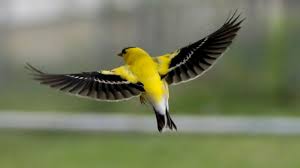
During my presentation I've not only learned about my bird but I also learned how I can improve the way I present. I need to present my voice by talking a little more louder and clearer. Also, I need to watch my hand gestures so that I don't mistakenly distract anyone during the presentation. My Presentation was on the American Goldfinch. This little finch is the state bird of New Jersey, Iowa, and Washington, commonly at feeders, where it takes sunflower and Nyjer seeds. Spring males are bright yellow and shiny black with a bit of white. Females and all winter birds are more dull. The Goldfinch's main natural habitats are weedy fields and floodplains, where plants like thistles and asters are common. They can also be found in cultivated areas, roadsides, orchards, and backyards. American Goldfinches can be found at feeders any time of year, but mostly during winter.
Monday, August 24, 2015
Red Wing Blackbird
I learned a lot making this presentation, not just about the Red Wing Blackbird but about birds in general. The bird I did my presentation on was the Red Wing Blackbird or also known as Turdus iliacus in Latin. Turdus meaning slow and iliacus meaning abdominal pain. A physical description of the bird is all black with red patches on its wing and yellow wing bars. However that's for males, females are more of a brownish color with spots of orange on its face. This bird behavior is very normal, but they are attention seekers. Males and Females go around on high branches singing to be noticed. They are located all over the United States so you can find them at golf courses, saltwater marshes, and crop fields.When its winter time they go to Canada to migrate. There so many of them around the US that they are least concerned about being extinct. They eat food such as blueberries and blackberries, but they also eat a lot insects. This is what i learned from my presentation.

Thursday, August 20, 2015
Great Blue Heron
During doing this presentation I learned a lot about my bird (Great blue heron). Before doing this presention I dident know this bird even exist. The Latin name for the Great Blue heron is Ardea Herodias. The great blue heron is a pretty big bird compared to other birds. It can stand from 60cm tall. It can weigh from 2.1-2.5 kg. I found it really integration that it can eat a pretty big fish in one bit. On my video it hoped its mouth and ate the fish in one bit. I found that very fascinating. The great blue heron in both fresh water and salt water. This bird lives all around North American and migrates to Central America. Great blue herons eat almost everything that is around them. They eat fish, small insects and other small birds. The great blue heron is least concerned. Without doing this presentation I wouldn't know what I know now about the great blue heron.

Subscribe to:
Posts (Atom)