Search This Blog

Tuesday, August 9, 2016

White Throated Sparrow


The White Throated Sparrow also known as Zonotrichia albicollis are very abundant and are of least concern. The males and females have the same brownish color along with a very bright eyebrow. While the juvenile is duller and doesn't have that yellow eyebrow. They live in Canada, the Northern US, and Northern Midwest. They won't migrate very far because they try to stay close to their homes. They will eat anything from bugs to seeds to fruit. When they try to mate the male will become aggressive to try to impress the mate and to try to scare off any competitors. They will also sing to the female to try a different way to attract her. When they find a mate they lose their aggression. So the White Throated Sparrow is a very interesting bird and can be a very cute one.

Friday, August 5, 2016

Northern Mockingbird


The Northern Mockingbird, otherwise known as Mimus Polyglottus, is a grey medium-sized songbird that is mostly recognized for its endless singing and its outstanding ability to mimic various sounds. These birds can be found all throughout North America. Although, these birds rarely migrate, there are times when they will go further south. This only occurs when the weather is really cold. Being an omnivore, this bird eats a wide variety of fruit and insects, such as berries and beetles. This species can as well be found in habitats such as parks, residential areas, farmlands, or any grassy areas with hedges or thickets. During mating season, the male Northern Mockingbird can attract a female by first establishing a territory. Once this is done, the male bird will chase her around while singing to her. He will also perform a flight display, which shows off their beautiful white wing patches.

Thursday, August 4, 2016

Wild Turkey

      The Wild Turkey, also known as, Meleagris Gallopavo, is a relatively large and heavy bird. When it comes to flight, having a wingspan as wide as the average height of a 13 year old boy might seem like an advantage, but due to their heavy weight Wild Turkeys spend most of their time on the ground foraging on food. Their diet consists of nuts, seeds, fruit, plant matter, and other things, such as salamanders and even snails. Wild Turkeys can be found almost anywhere in the U.S. thriving year-round in open forests. They can also be found in Mexico and southern Canada. During their mating season male turkeys make gobbling sounds to attract possible mates and to warn off competition with other males. Providing no parental care, male turkeys spend most of their time trying to find their next mate instead of staying with a single female helping and caring for their future hatchlings ( Bad Fathers!). Therefore, being left helpless and alone, females are left with the babysitting all to themselves. Although managing to successfully nurture up to 17 hatchlings up to adulthood is never easy, especially for single mothers, Wild Turkeys are doing a great job at keeping their numbers high. With a global breeding population of 7.8 million and a rating of  7 out of 20 in the Continental Concern Score , Wild Turkeys are of least concern.

Wednesday, August 3, 2016

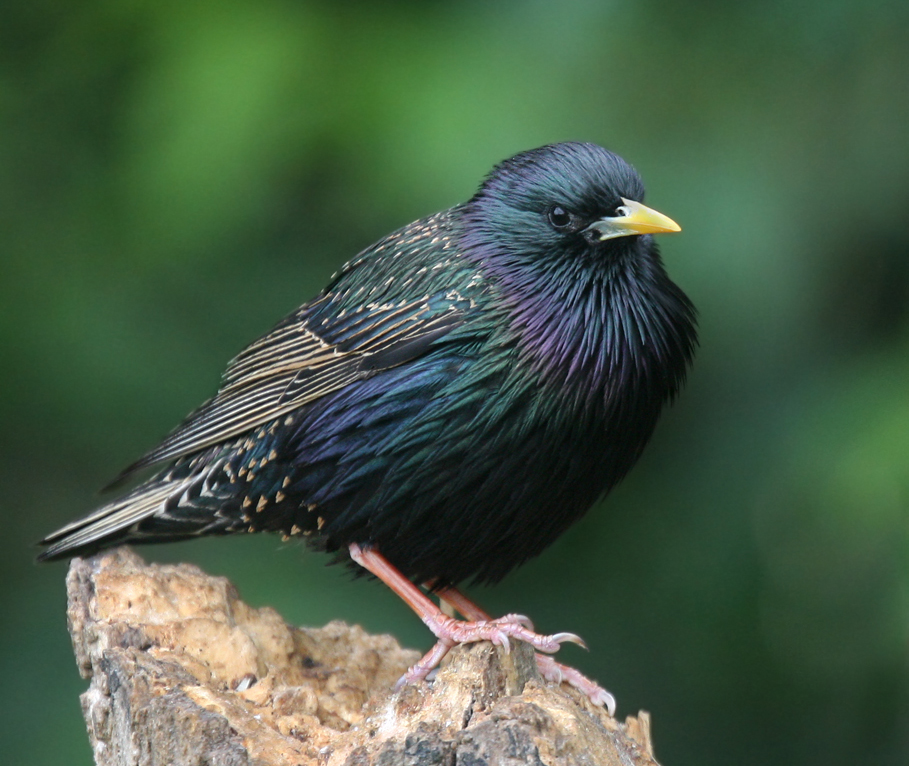
European Starling

The European Starling is a rather common bird and is the least of our concern. With it's glossy black feathers with a purple-greenish iridescent color to to them, both sexes are the same height, length, and wingspan. Both of the parents stay with the egg and incubates the egg until it hatches. The egg process can take up to 12 days.Starlings like to eat almost any thing, from things like insects garbage, fruits and plants like sumac. They were brought to us by Shakespearean enthusiast in the nineteenth century who really admired their great mimicking ability. These birds are everywhere throughout the United States and some parts of Canada. The adults like to migrate 40 degrees north  while the younger ones like to migrate to the south. In the winter, their black (summer) feathers molt and are replaced with brown feathers with white dots. Most like to spend their day sitting on a wire or in a tree making weird noises,


Tuesday, August 2, 2016

Mourning Doves

Mourning Doves


     Mourning Doves can be found almost anywhere around us in the U.S. With an outstanding 350 million soaring the skies and roaming the ground they are least concerned even while 20 million of them are being hunted every year. As a member of the Columbidae family Mourning Doves mostly eat seeds such as corn, millet, safflower, and sunflower seeds which makes up 99 percent of their diet.
Mourning doves migration differs from other birds because of their order. First the young leaves first, second the females, last of all the males. Not all of the males migrate some of them decide to stay in the North. Mourning birds Use the Coo sound howl to verify many things, to look for mate, claiming territory, and raising the young. The Mourning Dove can be found almost anywhere in the U.S. and are easily spotted with their Brown and Tank colored feathers which highly differs
from the Rock Pigeon.

Monday, August 1, 2016

Gray Catbird

          The bird I did my Presentation on was the Gray Catbird which is a medium size bird that is slate gray, reddish undertail covert, and a dark eye and bill. The Gray Catbirds can be found in dense shrubs, and thickets of young trees in both the winter and summer. Catbirds from across North America to spend their winters along the Gulf Coast from Florida. Once the bird finds a good area they make their nest 3-10 feet from the ground made out of grass, twigs, weeds, and pieces of trash. they have nesting they usually have 3-5 eggs that has a greenish blue color. The food that they eat is insects like ants, beetles, and grasshoppers, they also eat fruit like blackberries, cherries, and elderberries. The interesting thing about catbirds they meow like actual cats so You never know if it's a cat or a catbird making meow sounds.

Blue Jays

Blue Jays are common bird to see in the Eastern/Central part of the United States. There scientific names are are Cyanocitta Cristata, which stands for Crested Blue Chattering Bird. Males and females have the same physical traits, crest, black breast band, and black eyeline. Even their blue, grey and white top coat is the same. There mating is a bit peculiar though, 3 to 10 males will follow a single female and try to serenade her with head bobbing and mating calls. Only one luck male will be picked to be the life long mate of that female, and to strengthen that life long bond the male will bring food to her. Blue Jays live almost most anywhere but they can be usually found near oak trees because of there fondness for acorns. A Blue Jays migration style is all over the place sometimes the will migrate south sometimes they wont it depends on them. Blue Jays eat pretty common bird stuff, insects, seeds acorns. They have been sometimes to known to eat the eggs and hatchings of other birds. Blue Jays are also pretty clever birds, they have a talent for mimicking calls of other birds like hawks and crows. They use this talent to scare other birds from feeders to get a easy meal.